Best Fire Pit Lighting for Ambiance: The Definitive Design Guide
The intersection of light and shadow defines the nighttime landscape, yet few elements are as difficult to balance as the illumination surrounding an open flame. When a fire pit serves as the centerpiece of an outdoor living space, the lighting design must transition from a functional safety requirement to an atmospheric layer that enhances, rather than competes with, the flickering warmth of the hearth. Achieving the best fire pit lighting for ambiance requires a departure from traditional “bright-and-even” floodlighting in favor of a layered, multi-dimensional approach that respects the biological and psychological effects of low-color-temperature light.
The complexity of this design lies in the physics of contrast. A roaring fire produces intense, localized light, which causes the human pupil to constrict, effectively plunging the surrounding environment into perceived darkness. Without strategic peripheral lighting, the area beyond the fire’s immediate radius becomes a “black hole,” creating an unsettling sense of isolation or insecurity. Conversely, over-lighting the space with high-intensity LEDs or cool-toned fixtures strips the fire of its visual dominance and destroys the intimate, primal atmosphere that makes fire pits so compelling.
This exploration treats the fire pit not merely as a heat source, but as a light fixture itself one that dictates the color palette and intensity of every other light source in its vicinity. We will examine the technical nuances of Color Rendering Index (CRI), the atmospheric impact of beam angles, and the structural integration of lighting within hardscapes, providing a blueprint for those seeking to master the delicate equilibrium of the nocturnal outdoors.
Best fire pit lighting for ambiance
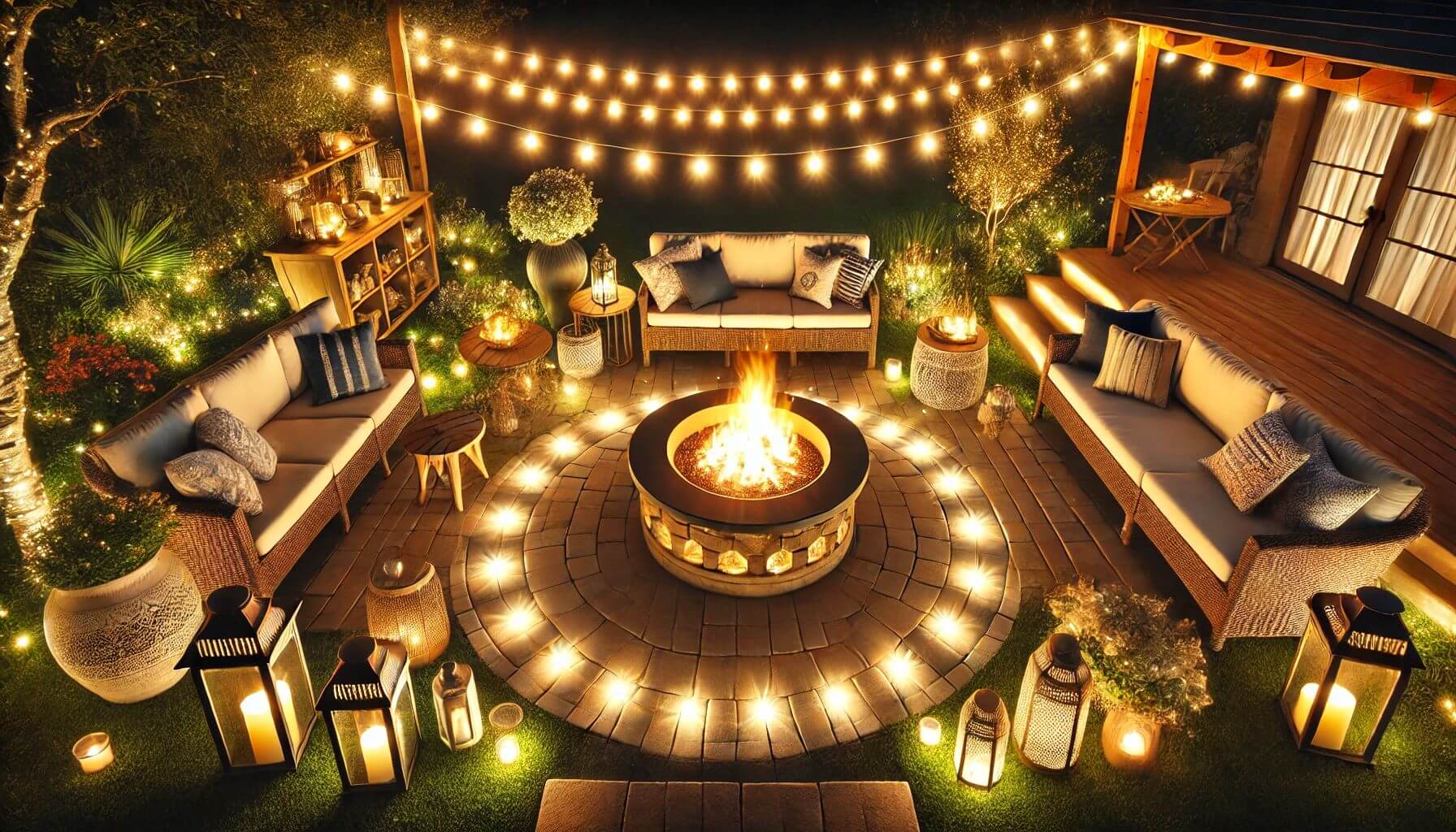
To identify the best fire pit lighting for ambiance, one must first dismantle the oversimplification that “ambiance” is a synonym for “dimness.” Ambiance is the result of intentional contrast ratios and the strategic placement of light sources to create a sense of enclosure and depth. The primary misunderstanding in outdoor design is the reliance on a single light source often a bright overhead light to do the work of four or five distinct layers.
True ambiance in this context is achieved when the artificial light mimics the natural behavior of firelight: warm, low-level, and directional. High-color-temperature lights (anything above 3000K) introduce a clinical, blue-tinted harshness that clashes with the 1800K to 2400K warmth of a wood or gas fire. Consequently, the “best” lighting is often that which is felt but not seen fixtures hidden beneath seating walls, tucked into tree canopies, or recessed into the ground to provide a soft wash of light that guides the eye without blinding it.
Furthermore, the search for the best lighting often ignores the “dark sky” principle. Over-illuminating an outdoor space creates light pollution and disrupts local ecosystems. The superior design focuses on task lighting for safety (steps and paths) and accent lighting for depth (trees and textures), allowing the fire pit to remain the focal point.
The Evolution of Nocturnal Gathering Spaces
The history of gathering around fire is as old as humanity, but the way we light the perimeter has undergone a radical transformation. Historically, the fire was the only source of light. This created a tight, intimate circle where anything beyond the embers was unknown. As residential landscapes evolved, the introduction of gas lamps and early electrical lighting moved us toward a period of “total illumination,” where the goal was to eliminate shadows entirely.
In the modern era, we are seeing a return to “chiaroscuro” the artistic use of strong contrasts between light and dark. The trend has shifted away from the utilitarian floodlight toward sophisticated, low-voltage systems that allow for precision control. This evolution reflects a deeper understanding of human circadian rhythms and the desire to create outdoor “rooms” that feel like sanctuaries rather than parking lots. We no longer just want to see where we are walking; we want to feel a specific emotional resonance with the landscape.
Luminous Frameworks: The Physics of Atmospheric Design

Designing the best fire pit lighting for ambiance requires applying specific mental models borrowed from cinematography and stage design.
The Three-Layer Principle
This framework suggests that every outdoor space needs three distinct types of light to feel balanced:
-
Ambient Layer: A low-level base of light that provides general visibility (e.g., moonlight filtered through trees).
-
Task Layer: Focused light for specific functions (e.g., path lights or step lights near the fire pit).
-
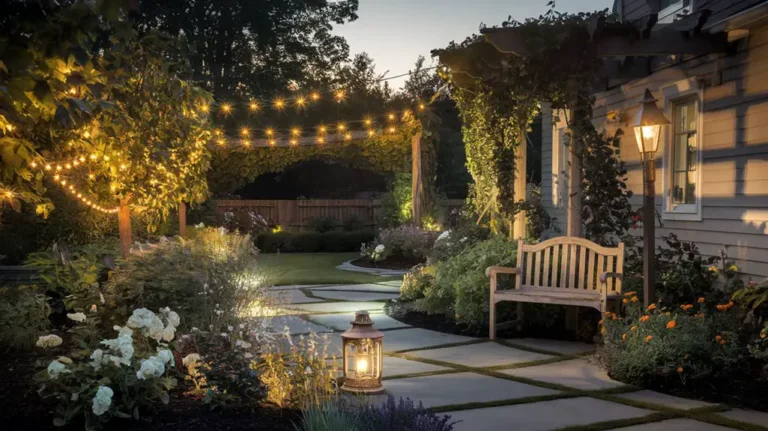
Accent Layer: Decorative light that highlights architectural or natural features (e.g., up-lighting a specimen tree behind the seating area).
The Golden Hour Model
Atmospheric lighting should aim to replicate the “Golden Hour” the period shortly after sunrise or before sunset. This involves prioritizing horizontal light over vertical light. Light coming from the side (grazing a stone wall) or the bottom (recessed deck lights) is inherently more relaxing to the human eye than light shining directly down from a high pole.
The Boundary Definition Framework
In a dark backyard, the “walls” of your outdoor room are the edges of the light. If you only light the fire pit, the room feels tiny. By lighting the distant perimeter perhaps a fence line or a group of shrubs you expand the perceived living space, making the area feel grander yet still secure.
Categories of Fire Pit Illumination and Trade-offs
Choosing the best fire pit lighting for ambiance involves navigating a variety of hardware categories, each with specific strengths and inherent weaknesses.
| Category | Primary Benefit | Significant Trade-off | Best Use Case |
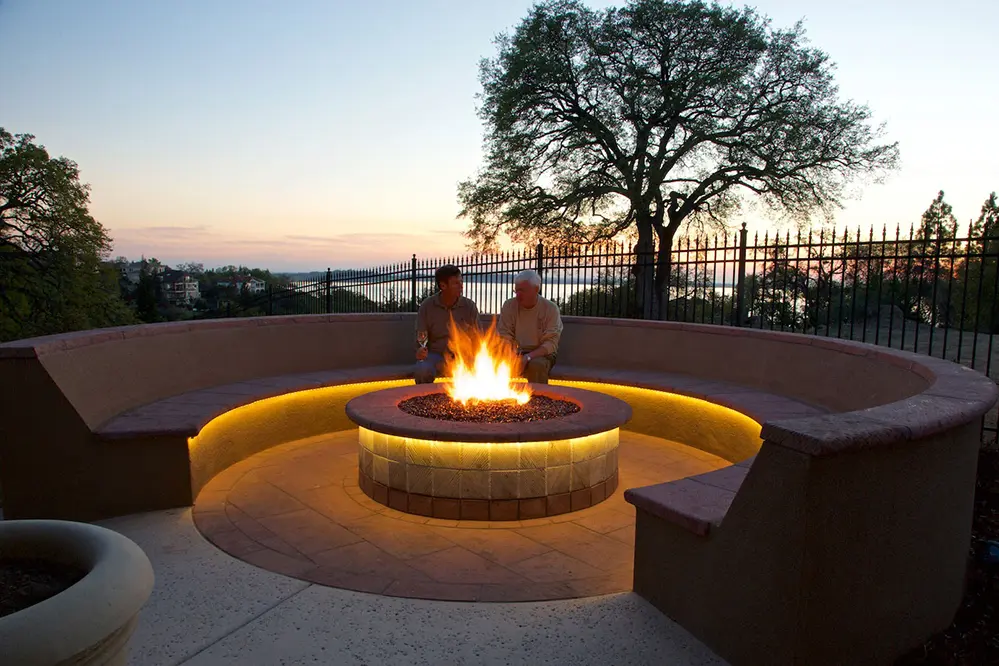
| Undercap Lighting | Hidden source; excellent for masonry. | Difficult to repair post-installation. | Retaining walls around the pit. |
| Moonlighting | Natural, romantic shadows. | Requires tall trees and professional climbing. | Large properties with mature oaks/pines. |
| Bistro/String Lights | Festive; high coverage for low cost. | Can look “cluttered” or cheap if overused. | Casual, overhead “ceiling” effect. |
| Path/Bollard Lights | Safety and directional flow. | Can create “runway” effect if spaced poorly. | Leading guests to the fire area. |
| Recessed In-Grade | Sleek; no trip hazards. | Prone to debris buildup and lens clouding. | Patios and walkways. |
| Smart Torch/Oils | Flickering, organic movement. | Fire hazard; requires constant refueling. | Temporary, high-mood events. |
Decision Logic for Fixture Selection
When selecting a category, one must weigh the “permanence” factor. Hard-wired, low-voltage LED systems (12V) are the gold standard for luxury and reliability. Solar-powered options, while improving, often lack the consistency and warm color temperature required for true ambiance. The logic should always be: Is the light source hidden? If the answer is no, the fixture itself must be aesthetically pleasing enough to be seen during the day.
Real-World Scenarios and Spatial Constraints
Scenario A: The Sunken Fire Lounge
In a sunken pit, the goal is to emphasize the subterranean feeling. Lighting should be placed at the lowest possible level.
-
Constraint: Poor drainage can short out ground-level fixtures.
-
Solution: Use IP68-rated waterproof strip lighting under the bench “lip.”
-
Failure Mode: Over-lighting the stairs leading down, which washes out the intimacy of the pit.
Scenario B: The Open-Field Fire Circle
With no walls or trees nearby, the fire pit is an island.
-
Constraint: Total darkness surrounding the pit creates a “void” feeling.
-
Solution: Use low-profile bollards or “puck” lights scattered in the grass to create a soft perimeter.
-
Second-Order Effect: Attracting nocturnal insects to the seating area if the lights are too bright.
Scenario C: The Wooded Retreat
A fire pit nestled among trees offers the perfect opportunity for moonlighting.
-
Constraint: Wind movement can cause “strobe” effects if fixtures are poorly placed.
-
Solution: Mount 2700K downlights high in the branches to filter through leaves.
-
Failure Mode: Nailing fixtures too tightly, which can damage tree health over time.
Planning, Cost, and Resource Dynamics
The financial investment in the best fire pit lighting for ambiance is often underestimated because homeowners focus on the fixtures rather than the infrastructure. A professional-grade system involves transformers, heavy-gauge wire, trenching, and potentially smart controllers.
Estimated Cost Ranges (USD)
| Component | DIY/Low-End | Professional/High-End | Variable Factors |
| Fixtures (per unit) | $20 – $50 | $150 – $450 | Material (Brass vs. Plastic) |
| Transformer/Controller | $50 – $150 | $400 – $1,200 | Wattage & Smart Features |
| Installation Labor | $0 (DIY) | $1,500 – $5,000 | Soil density, distance from house |
| Maintenance (Annual) | $20 | $200 – $500 | Cleaning, trimming, bulb replacement |
The Opportunity Cost of Cheap Lighting
Opting for cheap, high-Kelvin solar lights often results in a “cold” atmosphere that discourages use. The opportunity cost is the loss of the outdoor space’s utility during the shoulder seasons (spring/fall) when lighting is most critical for comfort.
Tools, Strategies, and Support Systems
To manage a complex lighting array, several tools and strategies are essential:
-
Dimmers: High-quality LEDs are now dimmable. Reducing the intensity to 20-30% often creates the best fire pit lighting for ambiance.
-
Zoning: Separating the fire pit lights from the path lights allows you to turn off the “utility” lights once everyone is seated.
-
Astronomical Timers: These adjust automatically to sunset/sunrise times, ensuring the lights are on when needed without manual intervention.
-
CRI (Color Rendering Index) Checkers: Ensure all bulbs have a CRI of 90+ to keep the wood, stone, and skin tones looking natural under artificial light.
-
Beam Spread Shields: Used to prevent “light trespass” into neighbors’ yards.
-
Brass and Copper Housings: Unlike aluminum, these materials patina over time, blending into the landscape.
Risk Landscape and Failure Modes
The primary risk in fire pit lighting is glare. Glare occurs when the naked light source (the bulb) is visible to the eye. This causes discomfort and ruins night vision.
Compound Risks:
-
Thermal Stress: Placing fixtures too close to the heat of the fire pit can melt housings or degrade LED chips.
-
Voltage Drop: Using wire that is too thin over long distances results in lights at the end of the line appearing dimmer and more yellow than those near the transformer.
-
Moisture Ingress: Poorly sealed wire connectors in a garden setting will eventually corrode, leading to system-wide flickering or failure.
Governance, Maintenance, and Long-Term Adaptation
A lighting system is not a “set it and forget it” asset. It requires a rhythm of oversight.
Layered Maintenance Checklist
-
Monthly: Clear debris (leaves, mulch) from ground-level fixtures to prevent overheating.
-
Quarterly: Clean lenses with a mild vinegar solution to remove hard water spots.
-
Annually: Check for “wire creep” where frost heaves may have pushed buried wires to the surface.
-
Bi-Annually: Adjust the aim of fixtures. As plants grow, they may begin to block intended light paths.
Measurement, Tracking, and Evaluation
How do you quantify “ambiance”? While subjective, success can be measured through qualitative and quantitative signals.
-
The “Squint Test” (Qualitative): If you have to squint when looking around the fire pit, the contrast ratio is too high or there is a glare source.
-
Lux/Foot-candle Levels (Quantitative): Use a light meter. The area around a fire pit should ideally sit between 0.5 and 2 foot-candles of artificial light.
-
Dwell Time (Behavioral): Track how long guests stay at the fire pit. Poor lighting often leads to subconscious fatigue, causing people to head indoors earlier.
Common Misconceptions and Oversimplifications
-
Myth: More lights are better. Correction: Fewer, well-placed lights create more drama and better ambiance.
-
Myth: LED lights are always “cold.” Correction: High-quality LEDs are available in “Very Warm White” (2200K), which perfectly mimics candlelight.
-
Myth: Solar lights are an equal substitute for wired. Correction: Solar lights rarely provide the lumen output or color consistency required for architectural-grade design.
-
Myth: You should light the fire pit itself. Correction: The fire is the light. You should light the area around it and the features guests look at from the fire.
-
Myth: Motion sensors are good for fire pits. Correction: Sudden light changes destroy the relaxing atmosphere; manual or timed control is superior.
Conclusion
The pursuit of the best fire pit lighting for ambiance is ultimately an exercise in restraint. It is a refusal to succumb to the “more is better” philosophy of modern illumination. By treating darkness as a canvas rather than an obstacle, one can use light to sculpt an environment that feels both expansive and protective.
Successful designs recognize that the fire is the protagonist of the evening. All other lights are supporting characters, there to provide safety, define the boundaries of the “room,” and ensure that the transition from the bright indoors to the soft outdoors is seamless. As technology advances, the tools at our disposal from smart-dimming LEDs to high-CRI optics only increase our ability to fine-tune this experience. However, the fundamental principles of warmth, low-angle placement, and respected shadows remain the timeless pillars of a truly atmospheric outdoor hearth.